Marcela Morán is an award-winning filmmaker and educator whose work centers on migration, identity, and sustainability along the U.S.–Mexico border. A ‘fronteriza’ herself, Morán was raised in Laredo, Texas, and Nuevo Laredo, Tamaulipas, México—experiences that deeply inform her artistic practice. She holds an MFA in Film from Ohio University and a B.S. in Radio-Television-Film from the University of Texas at Austin.
Moran’s films have screened at international film festivals, galleries, and conferences. In 2023, her documentary Cartneros won the ‘Waste Award’ at the Cinema Verde International Environmental Film Festival and ‘Best Direction’ at the Environmental Film and Screenplay Festival.
Morán is aProfessor of Communication at Texas A&M International University, where she teaches film and cinema studies. The National Endowment for the Arts, the Austin Film Society, Humanities Texas, the U.S. Department of Education, and the National Science Foundation have funded her endeavors.
Artist Statement:
My journey into documentary filmmaking began with a return to the borderlands of my youth. Having grown up in Nuevo Laredo and Laredo in the 1970s and 1980s, I returned in the early 2000s to find a dramatically transformed landscape. The exponential growth of both cities, the aftermath of 9/11, and the far-reaching effects of NAFTA had reshaped the region. Border crossings had become militarized, and migration patterns had intensified, particularly from Central America and southern Mexico. It was this shifting reality, along with the stories of those migrating through it, that drew me in. I was captivated.
This led to the creation of Casa del migrante (2005), a documentary chronicling the perilous journeys of migrants who ride atop freight trains, endure abuse, and find temporary refuge at Casa del Migrante Nazareth in Nuevo Laredo before making their final leap into the United States.
Casa del migrante was recognized with Best Documentary at the New York Downtown Short Film Festival in 2006 and screened in cities like New York, Chicago, Los Angeles, Houston, and Austin—places that echoed the destinations of many of the migrants featured in the film. One migrant’s words remain etched in my memory: “We all have a dream. It’s to get to the other side of the river… to better our families.” His voice, like so many others, speaks to the deep humanity often overlooked in policy debates.
Years later, my work would again take me to New York City, where I met Sandra while screening Casa del migrante. Our encounter became the foundation of Jornaleras (2015), which documents the lives of three immigrant women—Sandra, Rocio, and Carmen. Sandra became much more than a subject; she took on the roles of fixer and later producer, helping me earn the trust of the other women and shape the narrative from within. The project was filmed entirely by an all-female crew and centered exclusively on women, marking a pivotal shift in my practice—one that continues to guide how I approach storytelling, collaboration, and representation.
Across all my work, I am committed to amplifying the voices of those who are often unheard—people marginalized by systems that fail to recognize their humanity. These stories of struggle, survival, and dignity reflect generations of injustice and remain painfully relevant today.
Documentary filmmaking has offered me more than a lens—it has provided me with a means of connection, listening, and learning. Each film serves as a stepping stone, both a reflection of the past and a call to future projects that deepen this commitment. I remain guided by the people I meet, the stories they share, and the ongoing work of witnessing and creating with intention.
Marcela Morán July 22, 2026
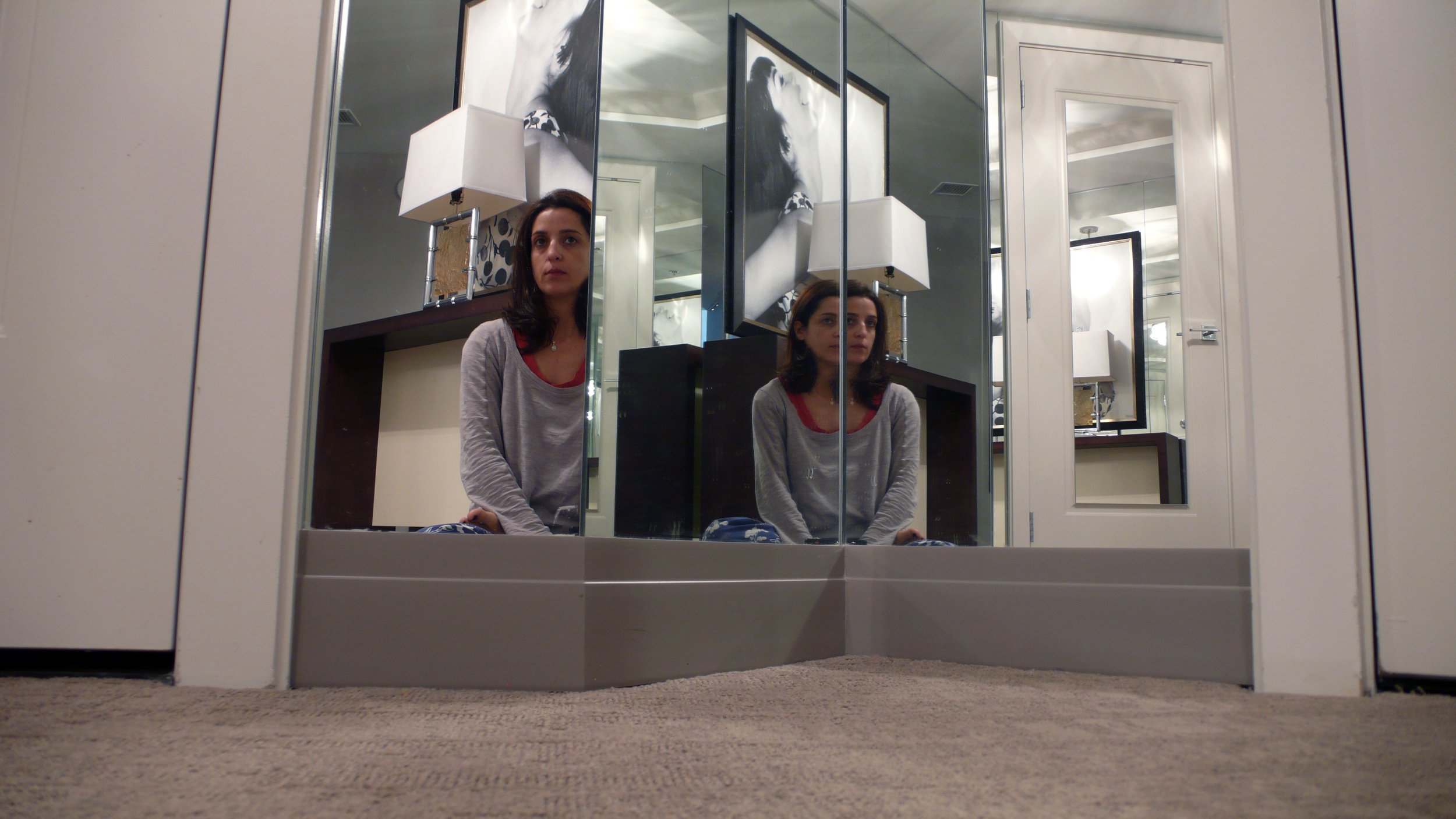
Self-portrait, The Cosmopolitan Hotel, Las Vegas, Nevada 2012.